 0975 721 441
 info@ailogisticsvn.com


The favorable mechanisms from Free Trade Agreements (FTAs) have helped Vietnam expand its trade space, boost import-export growth, and create significant demand for logistics services. However, despite numerous opportunities to integrate deeper into the global service supply chain, Vietnam's logistics industry still faces many challenges. Tuesday, February 24, 2026 - 06:26
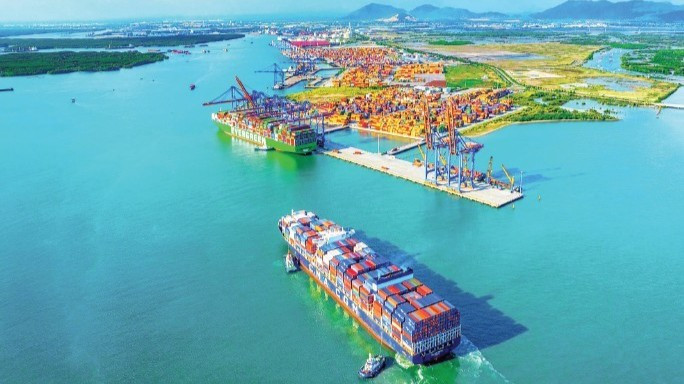
The Prime Minister has approved the Vietnam Logistics Service Development Strategy to 2030, with a vision toward 2050, aiming to make Vietnam a strategic logistics hub for ASEAN and the world, playing a pivotal role in the regional supply chain.
Persisting Challenges
In recent years, Vietnam's logistics services have grown strongly at an average of 14-16% per year, more than double the global average. The market size has reached approximately $45-50 billion, equivalent to 10% of GDP and 5% of import-export turnover. In 2025, Vietnam was ranked among the Top 10 emerging logistics markets, Top 4 in the region for the Logistics Opportunity Index, and Top 5 in ASEAN for the Logistics Performance Index.
However, according to Dr. Bui Ba Nghiem (Agency of Foreign Trade, Ministry of Industry and Trade), the logistics industry still faces many difficulties: infrastructure is not synchronized, and the development of railway, inland waterway, and road systems remains unbalanced. Deep-water port systems have potential but suffer from inefficient hinterland connectivity. Currently, only two ports are directly connected to the railway (Hai Phong and Cai Lan), while many high-capacity ports like Dinh Vu lack this connection.
Additionally, Vietnam's logistics costs have dropped from 20% of GDP in 2014 to about 16%, yet remain higher than regional neighbors like Singapore (8%), Malaysia (12%), and the global average (10-12%).
Long-term Development Strategy
On October 9, 2025, the Prime Minister approved the Vietnam Logistics Service Development Strategy for the 2025-2035 period, with a vision toward 2050. The strategy focuses on developing efficient and sustainable logistics services while enhancing corporate capacity.
To realize these goals, the Strategy prioritizes investing in large-scale, modern logistics centers in key economic regions and upgrading seaports, airports, dry ports, and international intermodal rail systems. It also prioritizes logistics infrastructure for e-commerce, smart warehousing, and green urban logistics.
Source: nhandan.vn