 0975 721 441
 info@ailogisticsvn.com


Incoterms 2020 & How to Memorize Them Quickly and Easily
Memorizing the 11 Incoterms 2020 rules, with their complex differences regarding the location of risk transfer and responsibility for costs between buyer and seller, can be a significant challenge. Mastering this set of international trade rules is crucial for avoiding costly disputes and ensuring smooth trade. Therefore, finding effective memorization methods will be the "golden key" to confidently applying Incoterms in your daily work.
Before attempting to quickly memorize the Incoterms 2020 conditions , you should first read and understand the Incoterms 2020 conditions in the article: Detailed content of Incoterms 2020.
1. What are Incoterms?
International trade, with its many differences in language, culture, laws, and political situations among participating entities in various countries, creates numerous risks and complex disputes. To mitigate and resolve these disputes, as well as to clearly define the responsibilities of the parties involved, many national and international legal documents have been developed, including discretionary legal documents such as the International Commercial Terms (Incoterms).
This set of customs, issued by the International Chamber of Commerce (ICC), includes rules guiding the use of international and domestic trade terms, facilitating trade development. Therefore, Incoterms can be understood as follows:
"Incoterms are a system of rules developed from international trade practices, aiming to guide the division of responsibilities for costs and risks among entities involved in international trade transactions."
The main purpose of Incoterms is to contribute to creating a generally applicable legal basis for regulating the responsibilities and obligations between sellers and buyers in the field of goods delivery, including: dividing costs and determining the point of transfer of risk of loss or damage to goods from the seller to the buyer.
When Incoterms are cited in a sales contract, they become the legal basis for resolving disputes in international goods delivery.
Incoterms 2020 is the ninth version of the Incoterms code. It includes 11 conditions and is divided into two groups as follows:
Seven conditions apply to all modes of transport, including:
- EXW – Ex Works (Delivered at the factory)
- FCA – Free Carrier
- CPT – Carriage Paid To
- CIP – Carriage & Insurance Paid to
- DAP – Delivered At Place
- DPU – Delivery at Place Unloaded
- DDP – Delivered Duty Paid
The following four conditions apply only to sea and inland waterway transport methods:
- FOB – Free On Board (Delivery on board the ship)
- FAS – Free Alongside Ship
- CIF – Cost, Insurance & Freight
- CFR – Cost and Freight
2. Notes on using Incoterms in international trade contracts
Incoterms are trade practices, not mandatory. They only become mandatory conditions binding the obligations and responsibilities of the parties involved in a contract for the sale of goods when the parties specify their use in the contract.
Later versions do not negate the validity of earlier versions. Therefore, when using them, it is necessary to specify which version of Incoterms is being applied for comparison and to determine the responsibilities of the parties involved.
Incoterms only explain the most general issues related to delivery, such as which party is responsible for arranging transportation or purchasing insurance, when the seller delivers the goods to the buyer, and how costs are divided between the parties. However, other issues such as price, payment methods, loading, unloading, warehousing, and storage depend on the agreement of the parties as stated in the contract or on port customs, industry customs, or customs of the countries where the parties involved in the transaction reside.
The buyer and seller may increase or decrease each other's responsibilities and obligations depending on their respective positions in the transaction, but this must not alter the fundamental nature of the delivery terms. Any increase or decrease in responsibilities and obligations (if any) must be specified in the sales contract.
Incoterms only define the point at which the risk of the goods transfers from the buyer to the seller; they do not define the point at which ownership of the goods transfers, nor the consequences of breach of contract. These issues are usually stipulated in other clauses of the contract or in the law governing the contract. The parties should also be aware that applicable local law may invalidate any part of the contract, including any previously selected Incoterms condition.
3. How to Quickly Memorize Incoterms 2020 - Super Simple!
Incoterms has 11 conditions, and confusion between them is common for those new to import and export. Therefore, Le Anh Import-Export provides the following guidelines in the hope that learners will not only memorize them quickly but also retain them for a long time, understanding the true nature of each Incoterms condition.
3.1 Memorization based on conditional groups
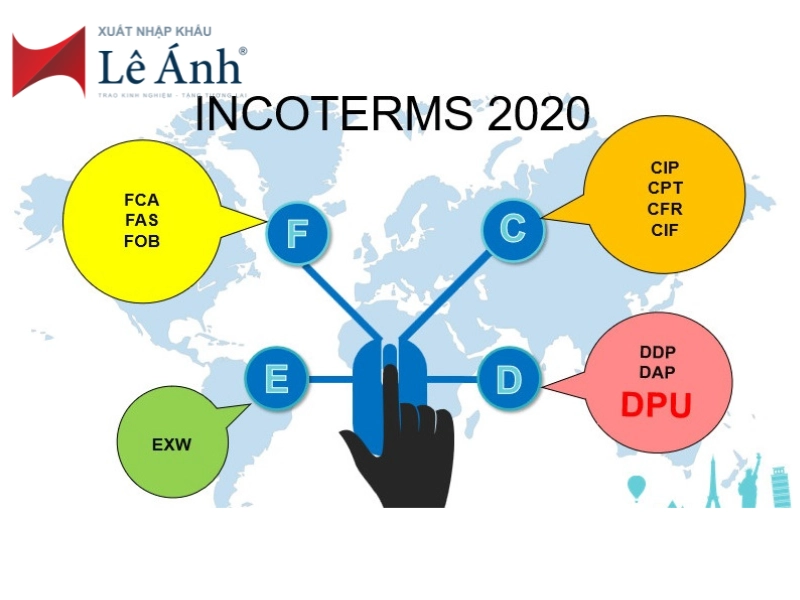
Instead of memorizing each condition in Incoterms 2020, you can visualize the four groups of conditions in order of increasing responsibility and risk for the seller, as follows:
|
E (You) - F (Right) - C (Try) - D (Go) |
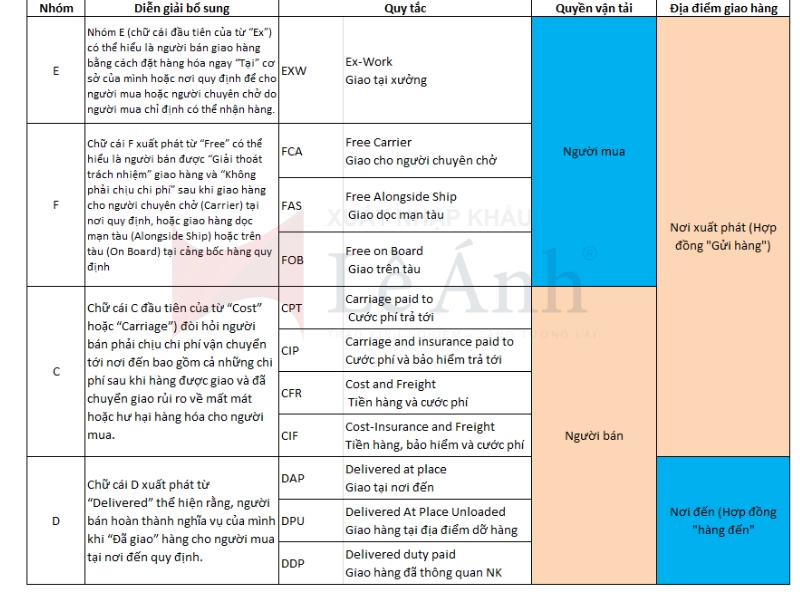
First, remember that the seller's responsibility and risk increase in order: E (EXW condition) has the lowest responsibility and risk, and increases to D condition where the seller's responsibility and risk are the highest. See the
following table for clarification:
3.2 Remember the location where the seller's liability for costs ends and the location where the risk transfers.
Name place - Designated location
The designated location is the location indicated immediately after the Incoterms condition. This is the location where the seller's responsibility for the costs of the shipment ends.
[Incoterms conditions, designated location, applicable Incoterms version]
Example : FOB Can Tho port, Incoterms 2020
In this example, Can Tho port is the designated location.
Delivery point
The place of delivery is the point at which the seller's responsibility for the risks associated with the shipment ends, and it is also where the seller fulfills their obligation to sell the goods.
The delivery location is not included after the Incoterms conditions and may or may not coincide with the designated location; therefore, the delivery location must be clearly specified in the sales contract.
The designated location and delivery address can be remembered and categorized according to the 11 conditions of Incoterms 2020 as follows:
|
group of conditions |
Condition name |
Designated location (Location where the seller is no longer responsible for costs) |
Delivery location (The point where the seller's responsibility for the risk ends - the risk transfers to the buyer) |
|
AND |
EXW |
Seller's workshop |
Seller's workshop |
|
F |
FCA |
The seller's premises or designated location at the departure point. |
The seller's premises or designated location at the departure point. |
|
FAS |
Departure port |
Departure port |
|
|
FOB |
Departure port |
Departure port |
|
|
C |
CPT |
Designated departure location |
Designated destination |
|
CIP |
Designated departure location |
Designated destination |
|
|
CFR |
Departure port |
Arrival port |
|
|
CIF |
Departure port |
Arrival port |
|
|
D |
DPU |
Designated destination |
Designated destination |
|
DAP |
Designated destination |
Designated destination |
|
|
DDP |
Designated destination |
Designated destination |
Thus, with the exception of group C conditions, all other Incoterms conditions have a designated location that coincides with the delivery location.
4. Incoterms Errors to Avoid to Minimize Risks
4.1 Risks of using FOB terms for containerized goods
FOB (Free On Board) is only transferred when the goods have actually been loaded onto the ship. However, for containerized cargo, the shipper usually delivers the container to the carrier at the terminal before it is loaded onto the ship.
Risk : Any damage to the container while it is awaiting shipment at the terminal is technically the responsibility of the shipper. This can easily lead to disputes, as the seller may argue that they have fulfilled their obligations, and ultimately the buyer often has to bear the costs to avoid damaging the relationship.
Solution : Use FCA, CPT, and CIP for containerized cargo. With these terms, the risk is transferred at the point of origin when the goods are handed over to the carrier.
4.2 No specific location specified
Failure to specify an exact location can lead to unnecessary disputes.
The problem : Incoterms rules allow for the specification of a particular delivery location. If only a general location is specified (e.g., "FCA Miami"), the seller is free to choose any delivery point that is most convenient for them within that area.
Risk: This can cause inconvenience and additional costs for buyers who have to transport the goods to their desired final location.
Solution : Always provide an exact address, such as a specific port or postal code.
4.3 Sellers use DDP/DAP without checking the feasibility of import procedures.
Sellers can run into big trouble if they don't prepare in advance.
The problem : Under DDP and DAP, the seller is responsible for costs at the destination. Especially with DDP, the seller must handle customs procedures and pay local taxes (such as VAT and GST). To do this, they may need to register as an importer in the foreign country, a process that can be very time-consuming.
Risk : If the seller is unable to fulfill these obligations, the goods will be delayed, and the ultimate responsibility remains with them because the buyer is not legally obligated to provide assistance.
Solution: Sellers need to ensure they can handle the procedures at the destination before committing to Group D terms. Buyers should also check whether their supplier is registered as an importer in the destination country.
4.4 Buyers use EXW without considering export procedures.
Similar to the error above, but the roles are reversed.
The problem : Under EXW (Ex-Works), the seller has minimal responsibility. The buyer is responsible for almost everything, including export procedures from the country of origin.
Risk : A common issue is loading. Under EXW, the seller is not obligated to load the goods onto the truck. If the buyer has to hire people to load the goods, the seller may not allow unfamiliar personnel into their premises for safety or legal reasons, leading to disputes over who is responsible if the goods are damaged during this process.
Solution: In many cases, FCA is a more practical and safer alternative.
4.5 Using CIP/CIF without checking the insurance coverage level.
The minimum insurance coverage required by law may not be sufficient.
Problem: Under CIP and CIF terms, the seller is obligated to purchase insurance for the goods. However, the minimum insurance coverage required by Incoterms (typically 110% of the contract value) may not be sufficient to cover all losses or meet higher requirements in the sales contract.
Solution : Always check that the insurance coverage provided by the seller is sufficient and in accordance with the terms of the commercial contract.
4.6 Choosing Incoterms that are not suitable for the payment method
This is especially important when using Letters of Credit (L/C).
Problem: With secure payment methods like Letters of Credit (L/C), payment is only made when the necessary documents are presented to the bank.
Risk : If using Group F (F-Incoterms) terms, the buyer is responsible for transportation and therefore has the right to interfere with the issuance of the Bill of Lading. This could prevent the seller from receiving payment.
Solution : Group C Incoterms are more suitable for payment by Letter of Credit (L/C), as the seller controls the shipment and therefore has control over the crucial documents required for payment, such as the Bill of Lading and Commercial Invoice.
Source: https://xuatnhapkhauleanh.edu.vn