0975 721 441
 info@ailogisticsvn.com


According to the Ministry of Agriculture and Environment, Vietnam's coffee exports in March 2026 are estimated at 210,000 tons, equivalent to a value of US$956.2 million. For the first three months of 2026, total export volume reached 577,300 tons, generating US$2.71 billion, an increase of 12.6% in volume but a decrease of 6.4% in value compared to the same period in 2025.
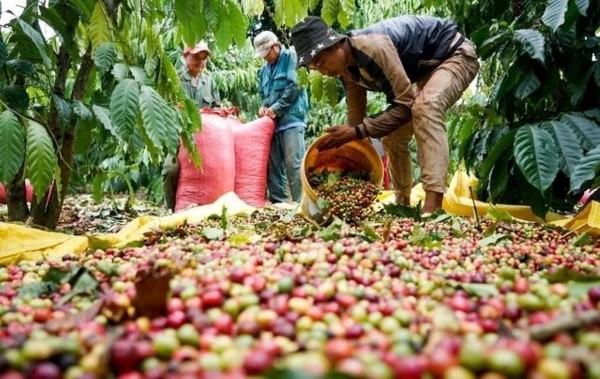
Coffee export volume in the first three months of 2026 increased by 12.6% compared to the same period last year.
The decline in coffee export value is mainly due to a sharp drop in the average export price. In the first quarter of 2026, the export price was estimated at US$4,696.8 per ton, 16.9% lower than the same period last year, resulting in a decrease in export value despite increased production.
COFFEE PRICES FALL, TRADING SLOW
In terms of markets, Germany, Italy, and Spain continue to be Vietnam's three largest coffee consuming partners, with market shares of 16.4%, 8.6%, and 7.6% respectively. Compared to the same period in 2025, exports to Germany increased slightly by 3.2%, to Spain by 14.1%, while exports to Italy decreased by 11.5%.
Notably, among the top 15 largest markets, China recorded the strongest growth, doubling compared to the same period last year, while the Philippines experienced a sharp decline of 23.9%. This development indicates that global coffee consumption demand remains stable but is shifting between markets, reflecting increasing competitive pressure and price volatility.
According to the Ministry of Agriculture and Environment, in March 2026, coffee prices in the Central Highlands decreased by 2,500-2,800 VND/kg compared to the previous month. Specifically, in Dak Nong, the purchase price reached 93,800 VND/kg, a decrease of 2,800 VND/kg; Dak Lak and Gia Lai were both at 93,700 VND/kg, a decrease of 2,700 VND/kg; and Lam Dong was approximately 93,000 VND/kg, a decrease of about 2,500 VND/kg.
Prices fell primarily due to the prospect of a record coffee crop in Brazil, the world's largest coffee producer. While disruptions to shipping through the Strait of Hormuz have somewhat increased logistics costs, this is not enough to offset global oversupply pressure.
The domestic market also saw relatively quiet trading activity as many farmers refrained from selling, hoping for a price recovery. Meanwhile, businesses needing to fulfill export contracts shifted to purchasing coffee from Brazil and Indonesia to ensure supply.
On the international market, coffee prices for March 2026 fluctuated in two opposing directions between Robusta and Arabica. For Robusta, improved global supply put downward pressure on prices. In March 2026, the price of Robusta futures for May delivery on the London exchange ranged from US$3,455/ton to US$3,772/ton.
Conversely, Arabica prices were supported by concerns about a shortage of high-quality coffee supply. May Arabica futures on the New York exchange reached a high of 317.85 US cents/lb and a low of 283.15 US cents/lb during the same period.
Entering the beginning of April 2026, both types of coffee declined. At the close of trading on the morning of April 3rd (Vietnam time), Robusta prices fell to $3,448 per ton, while Arabica also declined, reflecting the overall weakening trend of the market.
In the current context, the drop in coffee prices is causing concern among many producers, especially since the market trend in the coming period is still uncertain. Conversely, importers and processing businesses are benefiting from the decrease in raw material prices after a long period of high prices.
Experts believe that the strengthening US dollar, along with the prospect of abundant supply from Brazil and Uganda, are the main factors driving down coffee prices. In addition, news of expanding coffee cultivation areas in many countries is also impacting market sentiment, further contributing to the price drop.
Although coffee prices remain relatively high compared to previous years, the recent downward trend is causing concern among coffee growers. Production costs, particularly fertilizer and labor, continue to remain high, narrowing farmers' profit margins.
IMPROVE QUALITY TO INCREASE VALUE
In the face of market fluctuations, the Vietnamese coffee industry is under pressure to undergo a significant transformation, not only in terms of production volume but also in terms of quality and added value.
At the recent workshop "Expert Consultation on Robusta Quality and Market Transformation" organized by the Buon Ma Thuot Coffee Association, experts and businesses emphasized the importance of establishing a quality standard system for Vietnamese Robusta coffee.
According to Mr. Le Duc Huy, representative of the Buon Ma Thuot Coffee Association, Vietnam has affirmed its position as the world's leading producer of Robusta coffee. However, the advantage in production volume does not necessarily mean leading in quality standards or shaping value in the international market.
Therefore, the "Robusta XXI" initiative was launched to build a scientifically-based quality assessment framework, aiming to establish voluntary standards for Vietnamese Robusta coffee. This is considered an important step to enhance product value and increase competitiveness.
Opinions expressed at the workshop suggested that, in order to enter a new phase of development, the coffee industry cannot focus solely on increasing production but needs to pay more attention to measuring, standardizing, and building a "quality language" for its products.
Furthermore, building trust with international buyers is also crucial. Businesses expect that, if implemented effectively, the Robusta XXI initiative will contribute to building a quality ecosystem, helping Vietnamese Robusta coffee not only become a major export product but also have a voice in shaping global standards.
In the short term, the coffee market is projected to remain under pressure from increased supply and global economic volatility. However, in the long term, the Vietnamese coffee industry still has many opportunities if it effectively leverages its production advantages, while simultaneously transitioning to sustainable development and improving quality.
Deeper participation in the global value chain, along with initiatives like Robusta XXI, is expected to help Vietnamese coffee not only maintain its position in terms of production volume but also enhance its value and brand in the international market.
Source: vneconomy.vn